Lucien de Barenton, Count de Chrétien
The Moon and the SunLucien de Barenton, Count de Chrétien, is a favored and trusted courtier of Louis XIV, an organizer of royal business, and a man whose allegiance becomes increasingly difficult to separate from his care for Marie-Josèphe de la Croix. He first appears as a figure of the court’s practical machinery: arranging an expedition, directing servants, and attending the King. Later, he uses his position to intervene against violence, insists on the value of material evidence, and faces a choice between royal loyalty and the endangered Sherzad. His bearing is at once confident and vulnerable; he can name the privileges he possesses, but cannot make the final conflict disappear by invoking them.
Identity and Court Position
Marie-Josèphe initially knows Lucien by reputation rather than acquaintance. Mademoiselle d’Orléans, Lotte explains that he represented Louis XIV in organizing the expedition of Marie-Josèphe’s brother, Yves de la Croix, although Marie-Josèphe had not met him. This introduction places Lucien between the royal court and the expedition that brings the sea people into the story: he is not merely a ceremonial courtier, but someone entrusted with organizing consequential royal business.
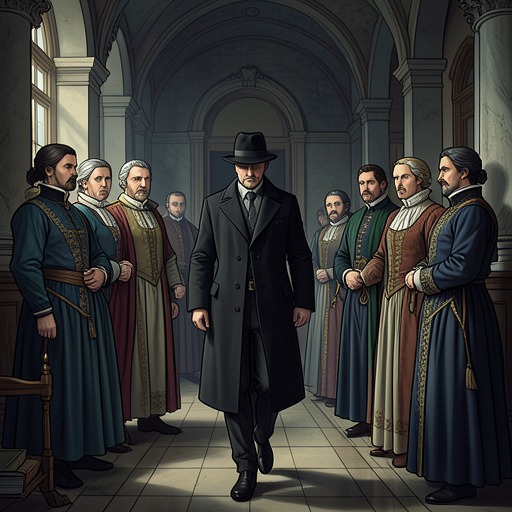
At the King’s arrival, Lucien’s rank and responsibilities are visible in his conduct and dress. He rides beside the royal carriage, wearing a gold-embroidered blue coat that marks him as a favored courtier, but his appearance departs from the fashions followed by many around him. He wears a short dirk rather than a sword, an informal scarf, and an auburn military-style perruke; his short mustache also recalls an army officer. Marie-Josèphe reads these choices as strikingly out of step with the court’s clean-shaven, more elaborate conventions. His status gives him latitude to disregard fashion, while his manner suggests an identity not wholly shaped by court display.
Lucien’s authority is also expressed through small acts of management. At the wharf he directs footmen to lay out a gold-and-scarlet silk rug so that Louis XIV will not have to step in the slime and fish remains. He calls for sedan chairs for the King and Madame de Maintenon, then opens the royal carriage door. The sequence presents him as a trusted attendant who anticipates practical needs and helps choreograph the King’s public appearance. His access is close, but it is exercised as service: he prepares the path on which royal authority will be seen.
Interventions and the Sea Monster
Lucien’s practical decisiveness takes a different form around the captive sea monster. As Marie-Josèphe attends to the creature, Lucien announces Louis XIV’s approach. He has crossed into the enclosure without her noticing, and stands on the fountain’s rim while Yves remains on the lower platform at water level. The staging places the two men face to face at different heights, with Lucien delivering the warning that the King is coming. His presence connects the creature’s private encounter with the demands of royal spectacle.
At another moment, when a driver is about to strike again, Lucien uses his ebony walking stick to catch the man’s wrist and stop the blow. The intervention is precise: the cane restrains rather than injures, and Lucien addresses the driver as the man realizes what he has nearly done. Lucien does not replace Marie-Josèphe’s effort to protect the creature; he makes that effort effective at a moment when the driver’s raised hand threatens to turn against her as well. The scene establishes a recurring distinction in his conduct: he can use the authority attached to his position to interrupt force, not only to carry out the King’s wishes.
His later defense of the sea woman’s account is less an act of physical restraint than an insistence on what can be known. When Louis XIV questions whether the stories are credible, Lucien says he believes Marie-Josèphe accurately describes what the sea woman sings, while acknowledging that there is no proof. He then produces Sherzad’s ruby ring, recovered from the coffin of the dead sea monster, and offers it to the King as evidence that Sherzad carried it when she was captured. Louis XIV challenges how Lucien can know this; Lucien answers by asserting the truth of his claim. The ring gives his testimony a concrete object, but his willingness to stake his credibility also matters: he speaks with a firmness the King has not previously heard from him.
Marie-Josèphe and Lucien
Lucien’s relationship with Marie-Josèphe moves from courtly acquaintance to declared love, but their exchange does not reduce affection to rank or advantage. After Lucien leaves the tent at the edge of anger, he sits by a pool and considers plunging into the water to cool himself, then recognizes that he might drown and chooses to remain angry. Marie-Josèphe runs to him, distressed and apologetic about Sherzad’s cruelty. She tells him that his spirit is beautiful and that he has allowed her to see his kindness, then says that she loves him.
Lucien answers with bravado. He describes himself as generous and as a knowledgeable lover, and readily admits that he is arrogant. His explanation enumerates the grounds on which he believes his confidence rests: an ancient title of the sword associated with the companions of Charlemagne, the trust of Louis XIV, and an inheritance of extensive lands and wealth. Marie-Josèphe rejects the idea that these distinctions are what draw her to him. She says she would feel the same even if he were not Lucien de Barenton, Count de Chrétien. Her declaration separates the man she loves from the titles and privileges he has just used to define himself.
Their intimacy includes a moment of recognition that Lucien does not welcome. Under the moonlight, Marie-Josèphe realizes that he is not the son of Louis XIV. Lucien says that he has already assured her of this and insists that he is his father’s son, speaking sharply as he tries to divert her from the dangerous insight. The exchange establishes a limit to what he is willing to discuss; it does not disclose the identity of his father. His response is guarded, even with someone who has declared that his title and position do not determine her love.
Loyalty, Risk, and an Unresolved Choice
Lucien’s attachment to Marie-Josèphe becomes inseparable from her effort to save Sherzad. Near midnight, when Marie-Josèphe explains that Sherzad has no other friend to be with her as she dies, Lucien sees through her attempt to present this as a mere reason for leaving supper. He tells her that she does not intend to let Sherzad die and warns that acting on that intention will bring her downfall. Marie-Josèphe says there is no word from the treasure ship; Lucien responds that although there was no news an hour earlier, he will find out. The exchange shows him recognizing both the danger of her course and the uncertainty that still surrounds the hoped-for ransom, without simply dismissing her decision.
The conflict becomes explicit when Louis XIV confronts Lucien during Sherzad’s attempted escape. Louis recalls that Lucien fought bravely beside him and asks whether he will now fight against him. Lucien cannot answer. Nearby, Marie-Josèphe and Yves are helping Sherzad toward the crest of a bridge, while Sherzad resists and struggles to move. Lucien’s inability to reply leaves the choice open at the point when royal loyalty and personal allegiance meet directly. The novel’s available evidence does not settle his decision in this moment; instead, it makes his hesitation consequential. The courtier who once prepared a clean path for the King now stands between the King’s command and the effort to save a captive, with the trust he enjoys no longer enough to reconcile the two.